




The 90-Day Reset: How I stopped doing everything and started growing

Benny Fisher • June 22, 2026

At a our recent Pond community founders session, I asked twelve founders to write down their top priorities right now. Business priorities. The things they're actively working to move forward.


The average answer was eight. One person had eleven. Nobody had fewer than five.


I'm not throwing stones. I've been that person. At one point I had so many priorities on my list that I carried it everywhere and accomplished almost nothing on it. The list made me feel productive. The results told a different story.


Here's what I've observed from working alongside home service entrepreneurs from $3M to $20M: the busiest people in the business are often the ones moving the least. Not because they lack drive. Because they've spread their energy across too many fronts and the force behind each one becomes thin.


The math doesn't work in your favor. Eight priorities means you're giving roughly 12% of your attention to each one. Important things get that 12%. Urgent things steal it. And at the end of the quarter, you look up and realize you've made incremental progress on everything and real progress on nothing.


WHAT KEY PRIORITIES TEACHES US 


When I work with clients inside their operating rhythm, we talk about their KEY PRIORITIES. The three to five things that, if you move them in the next 90 days, will make the biggest difference to the business.


Not twenty things. Not ten. Three to five.


The constraint is the point.


When you force yourself to name the three things that matter most, something important happens. You stop hiding behind the list. The low-priority items that felt urgent start looking like distractions. The important work that kept getting pushed down finally surfaces.


One of my clients in roofing had been "working on" their hiring process for over a year. It was always on the list. But when we sat down and made it a KEY PRIORITY, with a clear outcome and a weekly check-in, it moved in 45 days. Not because they suddenly found more time. Because they finally decided it was real.


Deciding something is real means making something else wait. That's the part most founders resist.


THE COST OF INFINITE PRIORITY


When everything is a priority, your team doesn't know what to protect. They're watching you, taking their cues from where you spend your attention. If you're scattered, they'll be scattered. If you keep pivoting, they'll stop trusting the plan.


Clarity is a form of leadership. When you say, "These three things, this quarter," you give your team something to organize around. You give yourself a filter for decisions: "Does this serve one of our three priorities? No? Then it waits."


That's not rigidity. That's focus. And focus, held for 90 days, compounds in ways that scattered effort never can.

THE EXERCISE WORTH TEN MINUTES TODAY


Write down everything you're currently treating as a priority. Get it all on paper.


Then ask: If I could only move three of these in the next 90 days, which three would change the business the most?


Circle those three. For right now, everything else is context, not priority.


I've watched founders do this exercise and feel almost guilty, like they're neglecting the other eight items. That feeling usually passes around day thirty, when the three things are actually moving and they can feel the difference.


Peace of mind and business momentum are not opposites. They tend to travel together. And both of them start with fewer priorities, held honestly, for 90 days at a time.


So tell me: what are your three right now?


If this article resonated with you, you can find more at BennyFisher.com

Prepared by Benny Fisher | Visionary Navigator | bennyfisher.com


Whether you're driving, building, or reflecting — catch every episode of The Big Fish Cares Podcast on your favorite platform.

Where Real Conversations Live

A button that says listen on apple podcasts on a white background.
A youtube logo that says watch and listen on youtube
A button that says listen on spotify on it

Looking for more? Start here.

Photo collage of The Pond members at events with the words Our First Anniversary
By Benny Fisher • November 12, 2026
Every roofing and business owner already has a pond. Why I learn more from failures in the room than wins, and what makes a peer group worth it.

A finish line on an open road that keeps going, a picture of a founder without a definition of enoug
By Benny Fisher • November 5, 2026
If you don't define enough, your vision will spend everything you have. Four questions to ask before the next round of growth, from Benny Fisher.

Gold handcuff on a dark brick wall with the words There's no lock on a gold handcuff, from The Deck
October 22, 2026
It started at 250 dollars a month and grew to 30,000. Losing all of it in one month was the release that let me build what I was actually called to build.

Show More
Photo collage of The Pond members at events with the words Our First Anniversary
By Benny Fisher • November 12, 2026
Every roofing and business owner already has a pond. Why I learn more from failures in the room than wins, and what makes a peer group worth it.
A finish line on an open road that keeps going, a picture of a founder without a definition of enoug
By Benny Fisher • November 5, 2026
If you don't define enough, your vision will spend everything you have. Four questions to ask before the next round of growth, from Benny Fisher.
Gold handcuff on a dark brick wall with the words There's no lock on a gold handcuff, from The Deck
October 22, 2026
It started at 250 dollars a month and grew to 30,000. Losing all of it in one month was the release that let me build what I was actually called to build.
Snow globe with a quiet winter scene and the words 30 minutes of silence, from The Deck
By Benny Fisher • October 13, 2026
The snow is not the problem. The shaking is. Why thirty minutes of silence a day is how founders find the vision that was already sitting there.

Why a weekly cash review gives home service founders fewer surprises and more peace.
By Benny Fisher • October 1, 2026
Most founders only check cash when panic hits. Here's the weekly cash review I give home service owners: same day, same time, 13 weeks ahead.

White tour bus on an open road with the words put six people in a bus, from The Deck
By Benny Fisher • September 22, 2026
March 2021, a Texas ranch, and six people from my leadership team. You cannot reheat a room. The conference is not the trip. The van is the trip.
One glowing figure standing in front of a team of dark figures, a founder who carries the care, from
By Benny Fisher • September 11, 2026
You can delegate the P&L, the hiring, the whole calendar. The care comes back every time, and it moves up to you. The founder's real job.

He Already Had Number Ten
By Benny Fisher • September 3, 2026
The ten disciplines from Gino Wickman and Rob Dube, handed to a friend on a back porch in July. Where I argue with the order, and the one discipline a man can hide inside.

By Benny Fisher • August 27, 2026
You never know what's going to happen at the intersection of one point in time and a few people willing to tell the truth.
By Benny Fisher • August 20, 2026
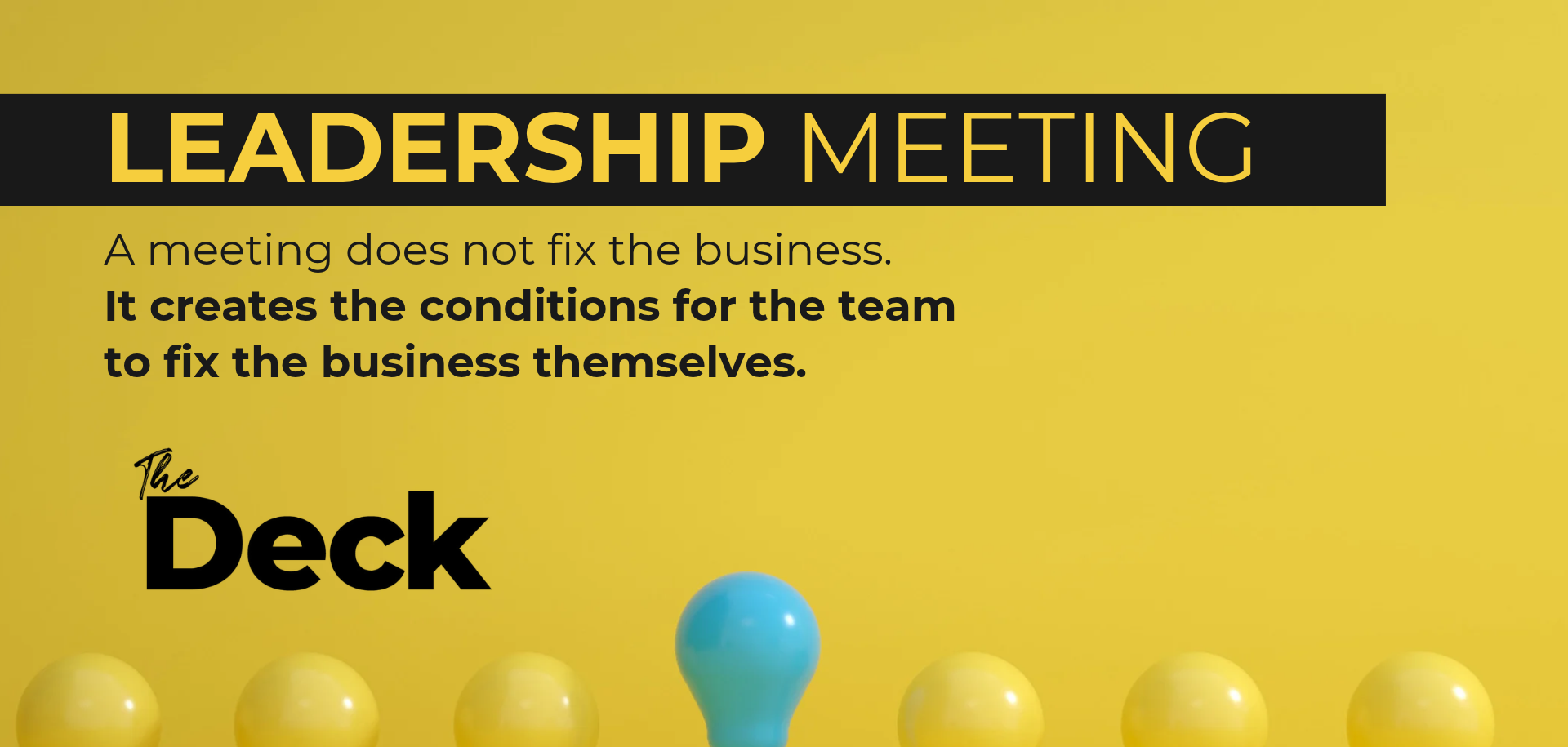
I walked into a leadership meeting with a client's team about a year into working with them. Twelve people around the table. Everyone had a status update. Everyone gave their status update. An hour later, we had a shared understanding of what had already happened and nothing had been decided. That is not a meeting. That is a group status email that required everyone to show up in person. WHAT A REAL LEADERSHIP MEETING DOES There is a version of the weekly leadership meeting that most teams never experience. One where the issues that have been bouncing around in people's heads all week get named out loud, get owned by the right person, and get resolved before they become next week's bigger problem. That version requires three things that most teams skip. First , the issues have to be named honestly, not diplomatically. Diplomatic issue identification produces incomplete lists. What you are actually worried about has to be said in the room, not saved for the parking lot conversation after. Second , they have to be solved at the right level. Most of the time the founder is not the right person. A mature team asks who is actually closest to this problem, and puts the solve there. Third , the priorities have to stay honest. Most leadership teams do not need more ambition. They need fewer things on the list, held with more discipline. When every item is labeled important, people quietly stop believing anything actually is. WHAT CHANGED WHEN THEY CHANGED THE MEETING We rebuilt the format with that client. Same people, same time slot, different structure. A short pulse on the numbers, a review of what moved and what stalled on the real priorities, then time to identify and solve the actual issues, not report on them. Three things happened in the first month. The founder stopped carrying half the company's unresolved issues home over the weekend. The team started solving things without waiting to be told. And the leadership conversations shifted from status reporting to real decision-making. The meeting did not fix the business. It created the conditions for the team to fix the business themselves. THE QUESTION TO BRING TO YOUR NEXT MEETING Before your next leadership meeting, write down the three things you are most worried about in the business right now. Not the agenda items. The real things. Then ask: do these get named and solved in our weekly meeting, or do they stay in my head until they become a crisis? If the answer is your head, the meeting needs to change. A business that still depends on the founder's nervous system to hold its unresolved issues has not yet built a real leadership team. It has built a group that reports to a person. What is sitting in your head right now that belongs in a room with your team? Prepared by Benny Fisher | Visionary Navigator | bennyfisher.com
Show More